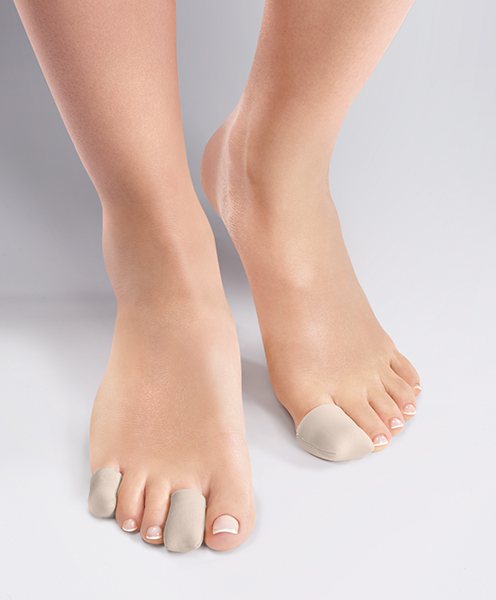
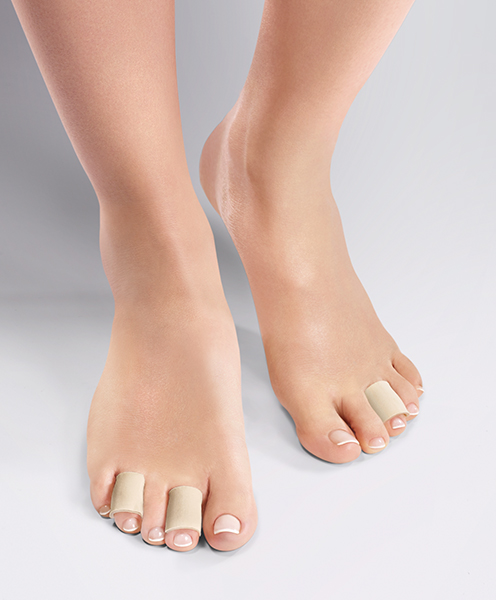
Deformed or placed in narrow shoes, the toes are subjected to very painfulpressures and frictions resulting in the formation of corn areas. To disable this process, you need to protect the skin for at least 1 month.
TRUE/FALSE
To overcome a horn or a partridge's eye, you must sand the horn or/and apply an ointment to remove the horn.
FALSE! By sanding the horn or the partridge's eye, we maintain the defense mechanism of the skin. Result: the horn will come back very quickly. As for keratolytic balms or ointments, they act chemically on the horn to make it disappear but do not attack the cause: contact with the shoe. To permanently prevent the formation of horn in the pressured zone, a gel must be interposed to distribute the charges.
A corn can only form on the toes.
FALSE! A corn is caused by excessive pressure, either related to the shoe or to the foot if it does not hit the ground properly. So, while walking, you might apply an excessive pressure under the forefoot. As a consequence, a corn can form. (Do not confuse a corn with a callus!)
There is only one type of foot corn.
FALSE! Several types of corn exist. For example, there is the simple corn, the vascular corn or neurovascular corn. Each type of corn will then lead to specific pain. For example, a vascular corn will easily bleed while caring. To learn more about corns, find out our article on the different types of corn and how to treat them.
 Contact
 Pharmacie