 Contact
 Pharmacie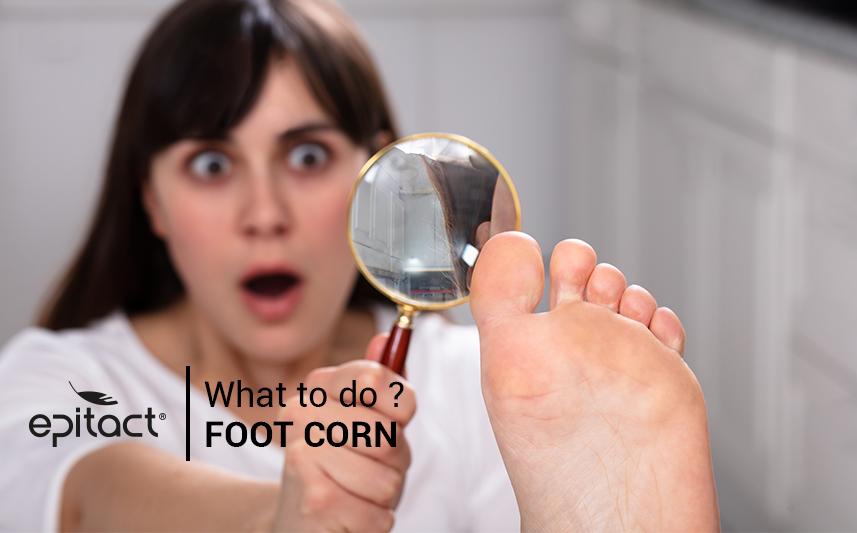
You’re ashamed of your toes? Your toes are deformed, they bend into claws or they are topped with corn?
Find out why and what to do to soothe the pain and to recover a daily comfort.
What’s a corn?
Foot corn is a callus or a localised thickening of the skin that is intended to protect from chafing or chronic pressures. The corn is composed of a round and dense stone made up of keratin and a point that reaches the deep layers of the skin.
How do corns form on the feet?
Corns appear progressively. If you are addicted to high heels, be aware that you’re inflicting a daily torture on your toes. By being constricted one against another in tight shoes for too long, your toes are creating a true armour of calluses for themselves. The more the calluses are thickening, the more the toes are lacking of room. High heels are putting too much pressure on them, forcing them to bend into claws (hammer toes)…
Corn and callus, what’s the difference?
Corn and callus are both callosities linked to a thickening of the keratin layer on the foot. However, the callus concerns generally callosities under the foot. Particularly, it forms under the arch of the foot, the forefoot or between the fingers and the palm of the hand. A corn, as for him, is often located on top of the toes but can also appear under the forefoot.
What differs a corn from a callus is the presence of a little point in the centre showing the excess of the maximal pressure that this area suffered.
The different types of corn
The corns are most of the time hard and painful. The pain caused by each movement implies a modification of supports.
A corn isolated on top of the toe (often on the joints) is called a dorsal corn.
A corn between two toes is called an interdigital corn. This type of corn is soft and spongy because it’s exposed to humidity. It can be painful. Most of the time, this type of corn is located on toes facing each other, one on each toe.
Lastly, a corn located at the tip of the toe is called a distal corn.
There are other corn types which location can change:
- vascular corn with little blood vessels in them bleeds very easily;
- neurovascular corn which compresses a nerve ending, very painful during treatment;
- Miliary corns that are little spikes of corn not so painful.
Who are the most affected by foot corn?
Corns can be found mostly in women for whom tight shoes and high heels are responsible. Corns can also be related to feet deformity such as hallux valgus which are also frequent in women.
Athletes are also exposed by their repetitive movements. Lastly, people whom skin is fragile and dry are also concerned such as old people.
What to do to reduce foot corn?
First, go to a shoe shop that can give you precious advice. Choose flat shoes or shoes with a low heel and wide tip that allow your toes to satisfyingly move. In summer, wide and open shoes will allow them a total freedom.
Then, your chiropodist can give you adequate care aiming to eliminate dead skin and calluses.
Improve your daily comfort thanks to the EPITACT® range of protections. You’ll limit the rubbing between your toes, reduce the development of corns and prevent other growth appearance.
EPITACT® DIGITUBES®* is recommended. It allows to isolate the toe from the shoe and its neighbours in a comfortable little tube.
For an interdigital corn, use a toe separator or DIGITUBES®* in order to separate it from the other toes.
The Digitops* aim to fight against distal corn.
To stretch your toes out and limit conflicts with your shoes, the hammer toe cushions* are recommended.
Lastly, to wear occasionally your court shoes, EPITACT® silicone protections are conceived to prevent corn between your toes.
*These products are class I medical devices that bear the CE marking under this regulation. Carefully read the instructions before use. Manufacturer: Millet Innovation. 05/2021.