 Contact
 Pharmacie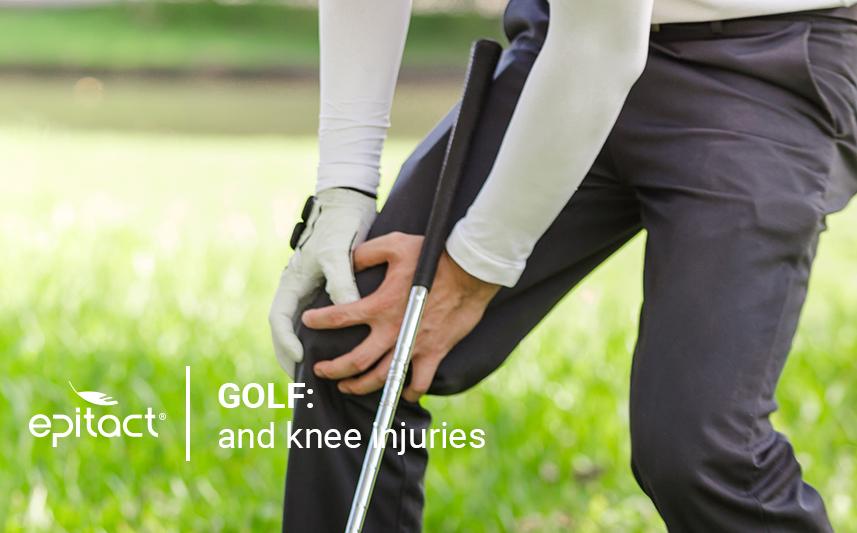
Feet aligned, legs semi-flexed, hands on the grip, you start your swing and your knee suddenly calls you to order! Indeed, knee problems are often revealed during golf. But what are the most common injuries and are they really associated with this sport practice? How to prevent and relieve pain?
EPITACT®, specialist in orthopaedic and podiatric care, unveil the link between golf and knee injuries!
Golf and the different knee injuries
In golf like in any sport, players are exposed to several types of injuries during the season. An international consensus has even demonstrated that amateur golfers are injured every 1000 hours of practice(1)! It appears logical once we know that a golf course represents a hiking of 8 to 12 kilometres… It becomes even worse with the repetition of movements during hours and hours to improve one’s swing.
The type of injuries varies according to the level of the golf player. For example, a professional golfer mainly suffers from injuries causes by overuses of joint or by a superior proximal tibiofibular joint instability. The finish phase of a golf swing also leads to microtraumas since it involves the deviation of the knee inwards (varus). It progressively causes the instability specific to golfers.
As for them, amateur players are more prone to common injuries that are not specific to golf practice. It mainly concerns knee osteoarthritis or the patellar syndrome.
The patellar syndrome
The patellar syndrome, or patellofemoral syndrome, manifests as pain caused by a wrong pathway of the kneecap in its track during knee motion. One or more misalignments of bones are responsible for excessive pressures between the femur and patella (kneecap). Most of the time, this syndrome has several causes: type of sports activity or osteotendinous ageing for example.
Adolescents are particularly affected by this knee injury. Up to 29% of them have this patellofemoral syndrome against 23% of adults. Women are also particularly subject to it compared with men (30% against 15%)(2). Finally, sportspersons specialised in one sport (like golfers) are specially concerned by this knee injury(3).
Knee osteoarthritis
Knee osteoarthritis is another risk for golf players. Also called gonarthrosis, it refers to the cartilage wear and so belongs to the category of joint injuries. Over time, the cartilage wear intensifies (either naturally or because of microtraumas and repeated excessive pressures). It may progressively lead to a bony contact!
The different structures that form the knee joint are the femur, kneecap and tibia. When one’s speaks about knee osteoarthritis, then it can concern one specific area. This is why several arthritides exist: tibiofemoral osteoarthritis, patellofemoral osteoarthritis or osteoarthritis affecting both joints.
In the case of osteoarthritis, playing golf can weaken the knees because it involves long walking distances on a non-flat surface. Moreover, keeping a semi-flexed position of legs and repeating it can end up causing pain.
Preventing knee pain
Always keep in mind that warm-up exercises for muscles before any sports activity, including golf, should never be underestimated! These exercises prepare the body for efforts, limit and prevent knee pain.
In addition, stretching exercises should be done regularly and systematically after each sport session. They contribute to joint flexibility and strengthening of muscles that support these joints.
Finally, relieving pain is also made possible by wearing devices specifically appropriate for the knee. In the case of gonarthrosis or patellar syndrome, the knee brace PHYSIOstrap™ Medical* by EPITACT® is indicated. For sportspersons like golfers whose knees suffer from osteoarthritis or patellar syndrome, a sport version* is available. It aims to stabilise the knee and consequently relieve pain.
Relieving knee pain in golf
If pain is intense or frequent, consult a health professional. It can be your doctor, sports physician or orthopaedist. After he has established the diagnosis, he will choose which care protocol is the most appropriate for you.
Depending on cases, he can recommend that you wear a knee brace. These braces hold the knee to relieve pain during movements without impeding them.
To learn more about the treatments of gonarthrosis and patellar syndrome, read our articles dedicated to these injuries.
*These products are class I medical devices that bear the CE marking under this regulation. Carefully read the instructions before use. Manufacturer: Millet Innovation. 10/2021
For more details about this general and simplified approach, here are further sources:
(1)Murray, Andrew, Astrid Junge, Patrick Gordon Robinson, Mario Bizzini, Andre Bossert, Benjamin Clarsen, Daniel Coughlan, et al. « International Consensus Statement: Methods for Recording and Reporting of Epidemiological Data on Injuries and Illnesses in Golf ». British Journal of Sports Medicine 54, no 19 (October 2020): 1136‑41. https://doi.org/10.1136/bjsports-2020-102380.
(2)Tamalet, Bertrand, Pierre Rochcongar, et Goulven Rochcongar. « La fémoro-patellaire : une articulation oubliée ? » Revue du Rhumatisme Monographies, Pathologies du genou - Première partie, 83, no 2 (1 avril 2016): 71 77. https://doi.org/10.1016/j.monrhu.2016.01.005.
(3)Willy, Richard W., Lisa T. Hoglund, Christian J. Barton, Lori A. Bolgla, David A. Scalzitti, David S. Logerstedt, Andrew D. Lynch, Lynn Snyder-Mackler, et Christine M. McDonough. « Patellofemoral Pain: Clinical Practice Guidelines Linked to the International Classification of Functioning, Disability and Health From the Academy of Orthopaedic Physical Therapy of the American Physical Therapy Association ». Journal of Orthopaedic & Sports Physical Therapy 49, no 9 (septembre 2019): CPG1 95. https://doi.org/10.2519/jospt.2019.0302.