 Contact
 Pharmacie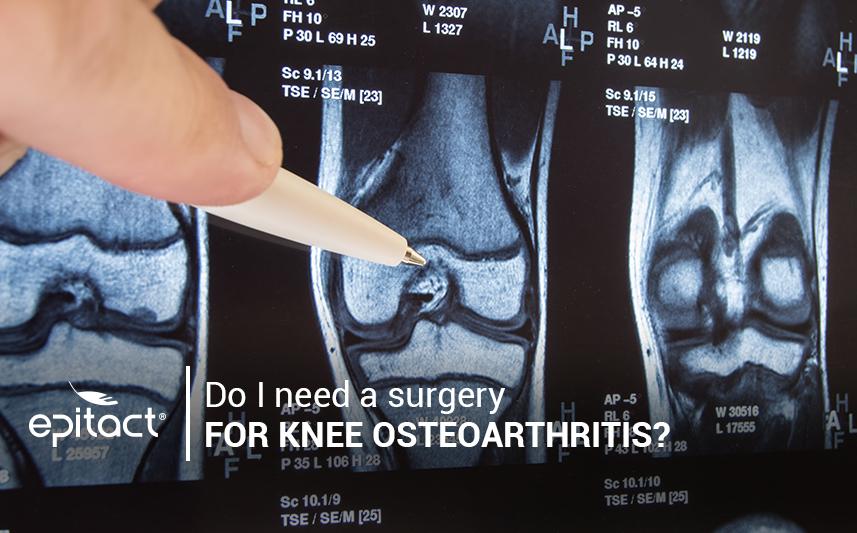
If conservative treatments are not successful (injection, anti-inflammatory drugs, etc.), it is frequent to consider surgery as an alternative to relieve pain associated with osteoarthritis. Indeed, if the functional handicap or pain become unbearable, having a surgery for knee osteoarthritis may be the final decision. Several surgical interventions are possible: description by EPITACT®.
Definition of knee osteoarthritis
Knee osteoarthritis, or gonarthrosis, is a joint condition related to the wear of the knee cartilage. The knee includes three bones: tibia, femur and kneecap. Osteoarthritis can partially of completely damage the joint. It is then referred to as bicompartmental knee osteoarthritis (more frequent) or tricompartmental knee osteoarthritis, respectively.
Do I need a surgery for knee osteoarthritis?
Having or not a surgery for knee osteoarthritis is a legitimate question in case of intense pain and functional discomfort. Indeed, all surgical interventions present risks: infection, postoperative complications, anaesthesia or trauma for example. Therefore, it is important to take into account the intensity, frequency and duration of pain, and to assess the daily discomfort such as decreased mobility. The stage of knee osteoarthritis and the damaged cartilage area caused by the condition are also criteria that could favour the choice of surgical intervention. In any case, medical consultation is required to diagnose and choose the appropriate treatment. However, it is essential that the patient is volunteer and does not feel pressured, it will facilitate the complete success of surgery and the recovery period.
Before considering this, it is recommended to undergo conservative treatments. The most common ones include injections, non-steroidal anti-inflammatory drugs or the use of knee braces. EPITACT®, the joint comfort specialist, has developed a knee brace for patellofemoral osteoarthritis: the PHYSIOstrap™ Medical*. The silicone tendon combined with a technical fabric surrounds the kneecap to stabilise it. Particularly thin and light, this flexible orthosis doesn’t impede the mobility and can be discreetly worn under clothes. A sport version* of this knee brace is also available.
Knee osteoarthritis: what surgical interventions?
To relieve knee osteoarthritis, three main types of interventions are possible: arthroscopic lavage, osteotomy and arthroplasty. These interventions for knee osteoarthritis aim to improve the daily comfort thanks to surgery.
Joint lavage in the arthroscopic treatment allows to remove foreign bodies (cartilage fragments...) and to adjust the meniscus to facilitate the mechanical movement of the knee affected by osteoarthritis.
Osteotomy consists in correcting the knee deviation to better distribute pressures by removing a small part of the tibial bone. As a result, the knee is realigned and supports are modified. This intervention is specially recommended when the patient presents genu varum (bow legs: knees are separated even when legs are closed) or genu valgum (knock knees).
Arthroplasty aims to replace the joint with a partial (unicompartmental prosthesis) or total prosthesis of the knee.
Rehabilitation is necessary to improve the degree of flexion after the surgical intervention. Depending on each case, it can be completed by physiotherapy sessions in office or in a rehabilitation centre.
Arthroscopic intervention: what durability?
An American study(1) including 180 patients concluded that after 24 months, people suffering from knee osteoarthritis who received arthroscopic lavage would get lower results (pain perception) than those who only had placebo incisions, without joint lavage. These researches, conducted in 2002, demonstrate the short-term benefits of such an intervention. Let’s notice that this type of clinical study (placebo) is not authorised anymore by the research ethics committee.
*These products are class I medical devices that bear the CE marking under this regulation. Carefully read the instructions before use. Manufacturer: Millet Innovation. 09/2021
For more details about this general and simplified approach, here are further sources:
(1)N Engl J Med. Juillet 2002 ; vol. 347 : p. 81-88. EULAREULAR recommendations for the non-pharmacological core management of hip and knee osteoarthritis - Ann Rheum Dis doi:10.1136/annrheumdis-2012-202745 - Published Online First 17 April 2013