 Contact
 Pharmacie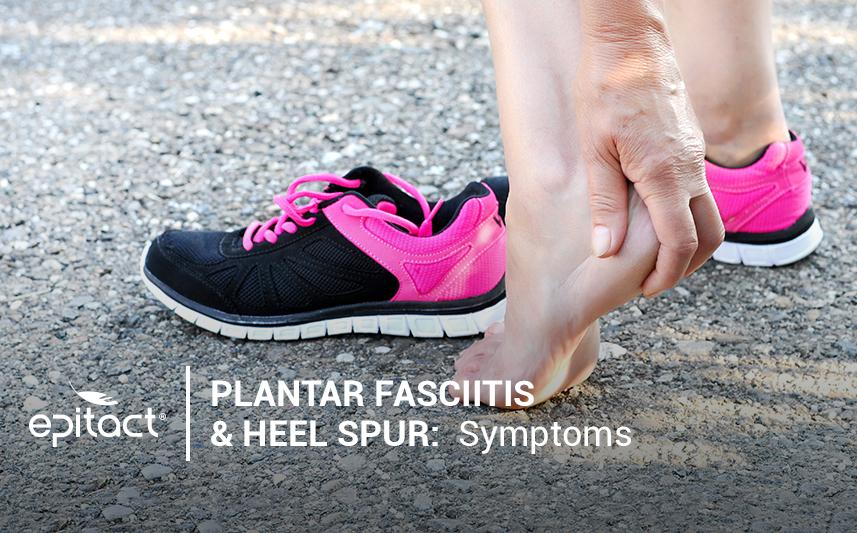
Often related, heel spurs and plantar fasciitis are both foot conditions with similar symptoms. You have heel pain and think the cause could be one of these conditions? With EPITACT®, discover the symptoms of a heel spur and plantar fasciitis, as well as their solutions to relieve pain!
Heel spur symptoms
A heel spur is also referred to as calcaneal spur, bone spur, osteophyte or exostosis. It corresponds to a bony excrescence at the base of the calcaneus, where the plantar fascia attaches on it. The plantar fascia is the triangular fibrous membrane that goes from the calcaneus to the base of the toes.
Because their symptoms are the same, patients with heel pain are often confused regarding the precise cause of their discomfort. Indeed, a heel spur would be present in 80% of patients with plantar fasciitis(1). Having a heel spur is commonly benign and painless, and its presence is only revealed by X-Ray.
In this case, which roles are playing these foot conditions in the onset of heel pain?

Heel pain: is it a heel spur?
A heel spur, bony outgrowth of the heel bone, is generally painless. Most of the time, heel pain is the result of the plantar fascia inflammation, where it attaches to the calcaneus. This inflammation can lead to the formation of a heel spur. In the end, the bony outgrowth is not the cause but the consequence of plantar fasciitis. Sometimes, the spur even remains after the inflammation has been removed. Also, it seems that the length of the spur (commonly a few millimetres long) has no relation with the intensity of pain.
However, a heel spur can lead to other symptoms like plantar fat pad atrophy. In this case, heel pain occurs where the spur forms and accentuates the already existing pain. This can have serious consequences on walking and mobility(2).
Plantar fasciitis symptoms
Inflammation of the plantar fascia appears to be the main cause of heel pain. Pain is one of the only, if not the only symptom of this condition.
Heel pain, as a symptom of plantar fasciitis, is recognisable by several characteristics:
Plantar fasciitis: symptom No.1: location of pain. Pain can appear in two different areas of the sole. Pain can affect the whole fascia or the heel (where the fascia attaches to the calcaneus). Therefore, it can be diffuse and radiate the sole of the foot or be localised under the heel.
Plantar fasciitis: symptom No.2: intensity of pain. People suffering from plantar fasciitis describe acute heel pain. They compare it with a burning sensation or a sensation of a nail being drove into the heel.
Plantar fasciitis: symptom No.3: frequency of pain. The painful symptom of plantar fasciitis usually occurs when the foot is supporting the body weight. It can be during prolonged standing positions, the morning while standing or after sitting for a prolonged period of time. It also appears after long work day or after some sports activities or when the foot hits the ground with force.
Plantar fasciitis: symptom No.4: aggravating factors of pain. As we’ve said, heel pain mostly appears when the heel supports the body weight (walking, running). A deviation of the foot or tight calf muscles are other aggravating factors of plantar fasciitis.
Plantar fasciitis: symptom No.5: relieving factors of pain. Heel pain decreases during motion or when the body weight do not press the inflamed area (rest, sitting position, etc.).
What solutions exist to relieve heel spur and plantar fasciitis symptoms?
To relieve the symptoms of a heel spur and plantar fasciitis, you can adopt the following solutions:
- rest: when the plantar fascia isn’t under strain anymore, inflammation reduces and so pain.
- insoles or heel lifts decrease heel pain caused by these foot conditions. By slightly lifting the heel, the heel lifts efficiently and comfortably reduce the tension on the plantar fascia. Therefore, the EPITACT® heel lifts* are the ideal solution. The thickness of the silicone pad provides comfort to the painful area. Then, the material used for the heel lift absorbs shocks every time the foot hits the ground. Designed to be ultra-thin and discreet in the shoe, they bring additional comfort while walking! Lastly, they’re adhesive, thereby perfectly holding in the shoes. They also contribute to decreasing joint and back pain.
- stretching exercises aim to stretch the foot tissues like the plantar fascia. They limit excessive tension on it and then reduce inflammation. The article by EPITACT® provides you all the information you need about these stretching exercises to relieve you.
Heel spurs and plantar fasciitis are both foot conditions responsible for the onset of intense heel pain. Click HERE to find out other ways to prevent this symptom and learn more about the treatments of heel spurs and plantar fasciitis.
*This product is a class I medical device that bears the CE marking under this regulation. Carefully read the instructions before use. Manufacturer: Millet Innovation. 01/2022
For more details about this general and simplified approach, here are further sources:
(1)Kuyucu E, Koçyiğit F, Erdil M. The association of calcaneal spur length and clinical and functional parameters in plantar fasciitis. International Journal of Surgery. 1 sept 2015;21:28 31.
(2)Mücke R, Schönekaes K, Micke O, Seegenschmiedt MH, Berning D, Heyder R. Low-Dose Radiotherapy for Painful Heel Spur: Retrospective Study of 117 Patients. Strahlenther Onkol. nov 2003;179(11):774 8.