 Contact
 Pharmacie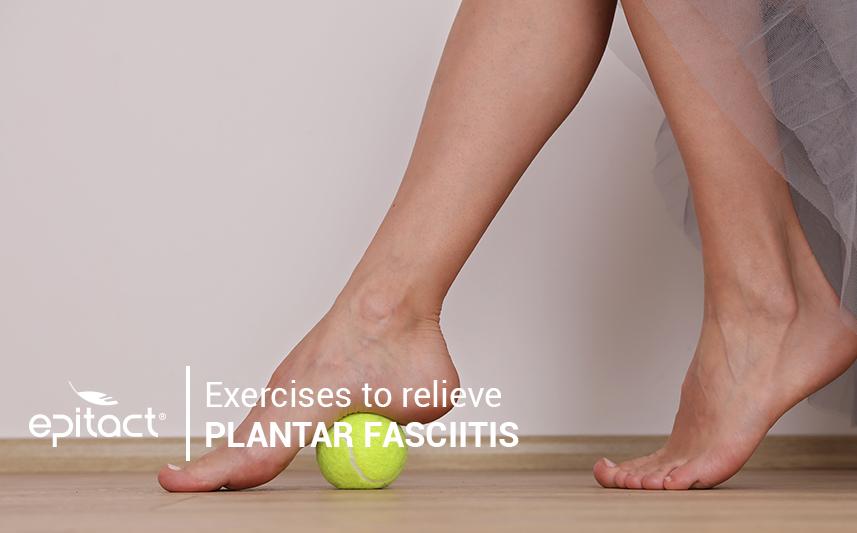
Intense pain under the foot or in the heel can be symptomatic of heel spur. This pain, associated with an inflammation, make supports and walking very uncomfortable. To solve this problem, some conservative treatments like simple exercises can relieve pain.
What is plantar fasciitis?
Plantar fasciitis is the inflammation of the plantar fascia (membrane that links up the heel and base of the toes). This inflammation can be caused by excessive use that leads to a protective calcification in the heel. The bone cells subsequently form a prominence called heel spur or calcaneal spur. The bony exostosis (spur) is not painful per se compared with the preceding inflammatory process.
What to do against plantar fasciitis?
To fight against this intense pain, several treatments exist, from the most conservative to the most invasive.
If pain persists, non-steroidal anti-inflammatory drugs could punctually relieve you (like aspirin or ibuprofen).
Wearing shoe lifts or insoles to relax the fascia and hold the arch of the foot is recommended(1). Using the heel lifts* soothes the sensitive area in the case of plantar fasciitis. EPITACT® suggests these shock absorbers intended to reduce shock waves and decrease plantar pressures, that is to say pain. Made up of two materials; one to absorb shock wave when the foot hits the ground, another (the silicone) to improve comfort, the PHYSIO’CHOC™ heel lifts* prove to be effective.
Finally, if these treatments associated with physiotherapy sessions or injections remain insufficient to relieve you, surgery is considered.
However, to avoid the condition to worsen, doing simple stretching exercises can have positive effects.
Massages or stretching to fight against plantar fasciitis?
Plantar fasciitis or plantar aponeurosis is one of the most common musculoskeletal disorder causing pain in the hindfoot. Nowadays, several therapeutic approaches to this condition are well documented and used as a reference. Among them, stretching exercises are prescribed with a high level of efficiency.
Researches to assess the impact of stretching on pain reduction have proved the benefits of these exercises.
One of these studies has demonstrated a pain reduction (especially in the case of fascia stretching) after 8 weeks. After 2 years, the pain has largely decreased in both groups, without significant difference between them. To conclude, fascia stretching is more effective in the short-medium term but no differences were recorded between massages and stretching exercises in the long term(2).
What exercises to fight against plantar fasciitis?
Two exercises have been studied: the first focuses on the plantar fascia, the second on the Achilles tendon(3). The first one consists in fascia stretching. While seated, place the painful foot on the knee (as if you were crossing your legs), then grab your toes and gently pull them towards you. Make sure to feel the tension in your fascia with your other hand. Hold this position for 10 seconds and repeat it 10 times, two to three times per day(4). Respect a rest period of 20 seconds between each stretching.

The second exercise consists in stretching the Achilles tendon (and consequently the calf muscle). To do so, stand upright facing a wall and take a step back with the painful foot. Your feet are perpendicular to the wall. The leg of the affected foot is straight, the other leg is flexed. Keep the heel of the painful foot in contact with the floor and bend forwards by leaning against the wall so that the ankle is flexed. You may feel your tendon stretch. Another method is to do these stretching exercises while seated on the floor, the legs straight. Then pull the ball of your foot backwards thanks to a folded towel. Like the previous exercise, repeat it 10 times for 10 seconds with a rest period of 20 second, two to three times per day.
Stretching the hamstrings is also useful because their tightness can aid the development of plantar fasciitis(5). Place your foot on a support with the leg straight to form an angle of 90° between your thigh and trunk. Adapt the height of the support depending on your flexibility. The other leg is straight, the foot flat on the floor.
The association of plantar pain with weakness of the foot muscles (intrinsic muscles)(6) is observed. To complete the aforementioned exercises, learn about muscle strengthening exercises for your feet by clicking HERE.
You can also massage your foot arch with a tennis ball by rolling it back and forth under your foot.
Doing these exercises on a daily basis should progressively reduce your symptoms, especially if you combine them with heel lifts*, dedicated to plantar fasciitis.
*This product is a class I medical device that bears the CE marking under this regulation. Carefully read the instructions before use. Manufacturer: Millet Innovation. 10/2021
For more details about this general and simplified approach, here are further sources:
(1)Martin RL, Davenport TE, Reischl SF, McPoil TG, Matheson JW, Wukich DK, et al. Heel Pain—Plantar Fasciitis: Revision 2014. J Orthop Sports Phys Ther. nov 2014;44(11):A1 33.
(2)Digiovanni BF, Nawoczenski DA, Malay DP, Graci PA, Williams TT, Wilding GE, et al. Plantar Fascia-Specific Stretching Exercise Improves Outcomes in Patients with Chronic Plantar Fasciitis : A prospective clinical trial with two-year follow-up. VO LUM E. août 2006;88-A(8):7.
(3)DiGiovanni BF, Nawoczenski DA, Lintal ME, Moore EA, Murray JC, Wilding GE, et al. Tissue-specific plantar fascia-stretching exercise enhances outcomes in patients with chronic heel pain. A prospective, randomized study. J Bone Joint Surg Am. juill 2003;85(7):1270 7.
(4)Lafuente Guijosa A, O’Mullony Muñoz I, Escribá de La Fuente M, Cura-Ituarte P. Plantar Fasciitis: Evidence-Based Review of Treatment. Reumatología Clínica (English Edition). janv 2007;3(4):159 65.
(5)Labovitz JM, Yu J, Kim C. The role of hamstring tightness in plantar fasciitis. Foot Ankle Spec. juin 2011;4(3):141 4.
(6)Huffer D, Hing W, Newton R, Clair M. Strength training for plantar fasciitis and the intrinsic foot musculature: A systematic review. Physical Therapy in Sport. mars 2017;24:44 52.