 Contact
 Pharmacie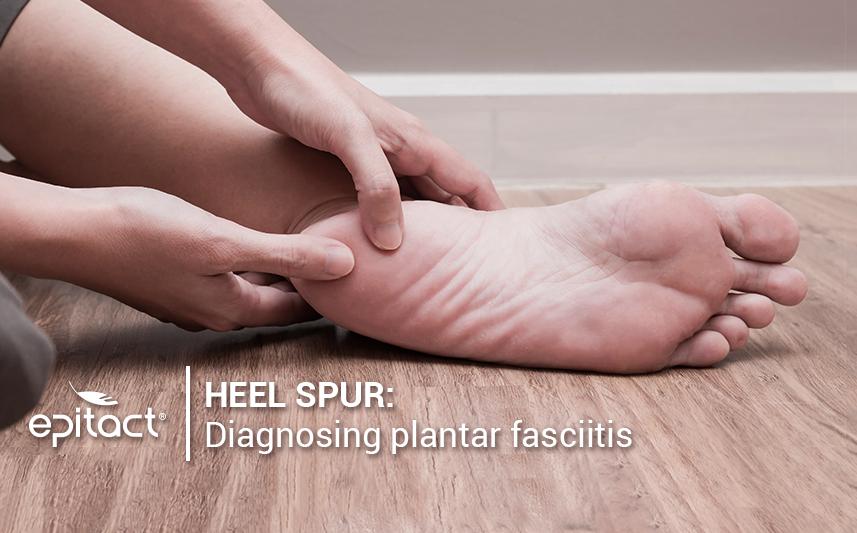
In the morning, your first steps are painful, as if a nail was piercing your heel. It may be a heel spur. But how to diagnose plantar fasciitisfor sure? What examinations are required to confirm the diagnosis of heel spur? Find out what are the steps in the diagnosis and the specialists who will establish it and suggest you a treatment appropriate for relieving your pain.
Definition of talalgia: plantar fasciitis
Talalgia corresponds to a pain in the heel. But this pain can affect different areas of the heel and have several causes. In the case of an infracalcaneal discomfort (under the heel) and after a thorough clinical examination by a health professional, the inflammation of your plantar fascia may be confirmed.
Plantar fascia is a fibrous membrane that links up the heel and the base of the toes. Not very elastic and located in the superficial layers of the plantar surface, it covers the other anatomical structures of the foot. The main functions of the fascia are:
• suspension;
• adhesion to the ground;
• foot support;
• role in the propulsion phase with contribution to forces transmission.
There are three main types of fascia involvement: enthesopathy, plantar fasciitis(diffuse pain in the fascia) and rupture.
Enthesopathy, or pain in the insertion of the plantar fascia on the calcaneus, is very frequent. It is closely linked with the presence of a heel spur . The latter is the consequence of an excessive traction on the fascia, at its insertion point, leading to microtears. The body tends to fight against this process by creating bone cells to strengthen the area subject to excessive use. These cells accumulate until forming a spur on the calcaneus, also called heel spur or calcaneal spur. However, the spur is not the one responsible for pain.
There is also plantar fasciitisor plantar aponeurosis. This pain is located in the fascia, under the arch of the foot.
Finally, another possible involvement is the rupture of the plantar fascia corresponding to its partial or complete tear.
These 3 conditions mainly result from mechanical problems. This article won’t deal with the inflammatory involvement due to diseases like ankylosing spondylitis.

How to diagnose heel spur ?
If you think having plantar fasciitis, it is recommended to consult a health professional. Your general practitioner will undoubtedly diagnose the condition you’re suffering from and advise you regarding the specialist to consult. The podiatrist and physiotherapist are often the first to intervene in the treatment.
After some questions by the physician to assess your pain, many clinical tests can help diagnose plantar fasciitis. How is established the diagnosis thanks to the clinical examination?
Very often, the pain manifests at the inferior surface of the heel (anteromedial aspect). It occurs from the first steps in the morning and decreases after about 15 minutes. It can also happen after prolonged efforts like an intense running. This pain progressively appears, at first in the dominant foot. Your answers to the physician’s questions about the pain onset, intensity, frequency and link with some supports are precious indications.
The most frequently identified symptoms during the clinical examination are:
• Pain on palpation of the insertion point of the fascia on the calcaneus (this pain is precise or localised);
• Pain can be more intense if the fascia is put under passive stress (ankle flexion and hallux extension);
• Absence of swelling (in the case it is swollen, it could indicate a fatigue fracture or plantar fascia rupture).
It is also possible to reveal a static or dynamic disorder of the foot and/or of the leg.
Your physician may prescribe you X-ray to eliminate all the differential diagnoses.
I have plantar fasciitis, what should I do?
Once the diagnosis is confirmed, your physician will provide you a treatment to suppress the symptoms (pain, sensitivity...) and eliminate the cause (inflammation, microtears, etc.).
In addition to massages and physiotherapy sessions, some stretching and muscle strengthening exercises can relieve pain.
Non-steroidal anti-inflammatory drugs can also complete the treatment protocol in case of inflammation.
These treatments are often combined with the use of heel lifts aiming to absorb shocks and slightly lift up the foot to reduce stresses.
EPITACT® has created the heel lifts* composed of two materials. The PHYSIO’CHOC™* softens the impact of the foot to the ground while the silicone gel in the centre makes supports more comfortable and distributes pressures. Pain is then relieved, walking and daily supports are facilitated.
*These products are a class I medical devices that bear the CE marking under this regulation. Carefully read the instructions before use. Manufacturer: Millet Innovation. 10/2021